CHI TIẾT VỀ CÂU TRỰC TIẾP GIÁN TIẾP (REPORTED SPEECH) TRONG TIẾNG ANH
CÂU TRỰC TIẾP – GIÁN TIẾP ( REPORTED SPEECH)
Câu trực tiếp – gián tiếp là một chủ đề ngữ pháp rất thường gặp trong các bài test Tiếng Anh : đó là viết lại câu từ trực tiếp sang gián tiếp.Hiểu được quy tắc chuyển từ câu trực tiếp sang gián tiếp và tình huống của câu trực tiếp sẽ giúp ta làm tốt dạng bài tập này.Hãy cùng English Mr Ban tìm hiểu chi tiết về chủ điểm ngữ pháp ” câu trực tiếp – gián tiếp ( reported speech)” trong bài chia sẻ dưới đây nhé.
I. Khái niệm câu tường thuật trực tiếp – gián tiếp ( reported speech)
Khi nhắc lại lời nói của người khác đã nói, ta có thể dùng câu tường thuật trực tiếp (direct speech) hoặc câu tường thuật gián tiếp (indirect speech). .
- Lời nói trực tiếp (direct speech): là nói chính xác điều ai đó diễn đạt (còn gọi là trích dẫn). Lời của người nói sẽ được đặt trong dấu ngoặc kép và nhắc lại chính xác từng từ đã được nói trước đó.Lời nói trực tiếp gồm 2 mệnh đề : Mệnh đề tường thuật + “mệnh đề được tường thuật”
Ví dụ: Nam said ,” His father is not at home”. ” His father is not at home” là lời nói trực tiếp hay câu tường thuật trực tiếp ( direct speech)
- Lời nói gián tiếp – câu tường thuật gián tiếp (indirect speech): Là thuật lại lời nói của một người khác dưới dạng gián tiếp, không dùng dấu ngoặc kép.Lời nói gián tiếp cũng bao gồm 2 mệnh đề : Mệnh đề tường thuật + (that) + mệnh đề được tường thuật.
Ví dụ: Nam said,”His father is not at home ” -> Nam said that his father was not at home là câu tường thuật gián tiếp (indirect speech)
II. Quy tắc chuyển đổi từ câu trực tiếp sang câu gián tiếp
Cả câu trực tiếp và câu gián tiếp luôn bắt đầu bằng một mệnh đề tường thuật, giống như lời dẫn. Theo sau là mệnh đề được tường thuật hoặc nội dung được thuật lại.
1.Nếu động từ của mệnh đề tường thuật dùng ở thì hiện tại thì khi đổi sang câu gián tiếp ta chỉ đổi ngôi; không đổi thì (tense) của động từ và trạng từ
Ví dụ :
– Van says : ” I am a student now” ⇒ Van says that she is a student now.
– She says : ” I am learning English here ” ⇒ She says that she is learning English here.
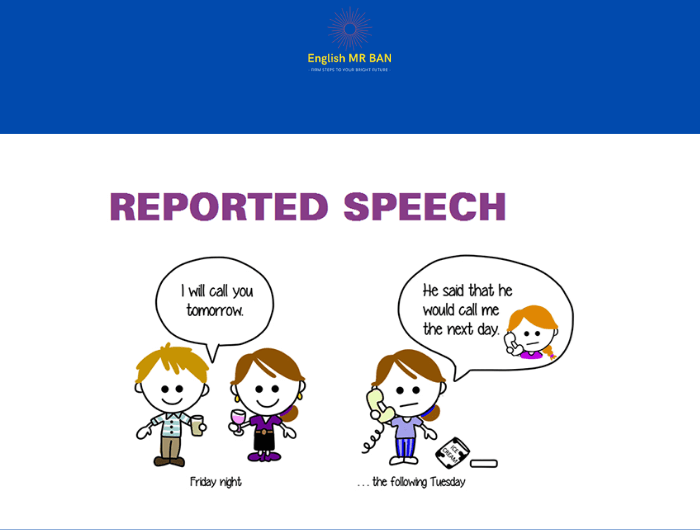
2.Nếu động từ của mệnh đề tường thuật dùng ở thì quá khứ thì khi chuyển sang câu gián tiếp ta phải lùi động từ chính về quá khứ một bậc,đổi ngôi, trạng từ chỉ thời gian và nơi chốn ở mệnh đề được tường thuật theo quy tắc sau :
A. Thay đổi ngôi ( Đại từ nhân xưng, Đại từ sở hữu, Tính từ sở hữu, Tân ngữ, Đại từ phản thân)
1. Ngôi thứ nhất: dựa vào chủ ngữ của mệnh đề tường thuật, thường đổi sang ngôi thứ ba
I → He / She
me → him / her
my → his / her
mine → his/ hers
myself → himself/herself
We → They
us → them
our → their
ours → theirs
ourselves → themselves
Ví dụ :
– He said: “I have studied English for two years.” → He said that he had learnt English for two years..
– She said to me : “My mother gives me a present.”→ She told me that her mother gave her a present.
– Hung said : “this house is mine” → Hung said that house was his
– Ba said : ” I drove myself to Sapa yesterday” → Ba said that he had driven himself to Sapa the previous day.
– They said : ” we are learning English now” → They said that they were learning English then.
2. Ngôi thứ hai: (You, your).Xét ý nghĩa của câu và đổi cho phù hợp, thường đổi dựa vào tân ngữ của mệnh đề tường thuật
Ví dụ :
– Mary said to me : “You are late again.”→ Mary told me that I was late again.
– “I will meet you at the airport”, he said to his girlfriend.→ He told his girlfriend that he would meet her at the airport.
B. Thay đổi thì : khi chuyển sang câu gián tiếp, thì của động từ ở mệnh đề được tường thuật phải lùi về quá khứ 1 bậc.
|
DIRECT SPEECH |
INDIRECT SPEECH |
| Simple present ( Hiện tại đơn) V1 /Vs(es) |
Simple past (Quá khứ đơn) V2/ V-ed |
| Present progressive (Hiện tại tiếp diễn) am/ is/ are + V-ing |
Past progressive (Quá khứ tiếp diễn) was/ were + V-ing |
| Present perfect (Hiện tại hoàn thành) have / has + P.P |
Past perfect (Quá khứ hoàn thành) had + P.P |
| Present perfect progressive (Hiện tại hoàn thành tiếp diễn) have / has been +V-ing |
Past perfect progressive (QK hoàn thành tiếp diễn) had been + V-ing |
| Simple past (Quá khứ đơn) V2 / -ed |
Past perfect (Quá khư hoàn thành) had + P.P |
| Past progressive (QK tiếp diễn) was / were + V-ing |
Past perfect progressive (QK hoàn thành tiếp diễn) had been + V-ing |
| Simple future ( Tương lai đơn) will + V1 |
Future in the past ( Tương lai quá khứ) would + V1 |
| Future progressive (Tương lai tiếp diễn) will be + V-ing |
Future progressive in the past ( Tương lai tiếp diễn trong quá khứ) would be + V-ing |
| Modal Verb (Động từ khuyết thiếu hiện tại)
Can |
Modal Verb in the Past (Động từ khuyết thiếu trong QK)
Could |
C.Thay đổi các trạng từ chỉ thời gian và nơi chốn:
| DIRECT | INDIRECT |
| Now/ Here | Then (at that moment) / There |
| This/ These | That/Those |
| Today | That day |
| Yesterday | The day before / the previous day |
| Last year | The year before / the previous year |
|
Tonight |
That night |
| Tomorrow | The following day / the next day/ the day after |
| Next month | The following month / the next month |
| Ago | before |
| The day before yesterday | Two days before |
| The day after tomorrow | Two days after |
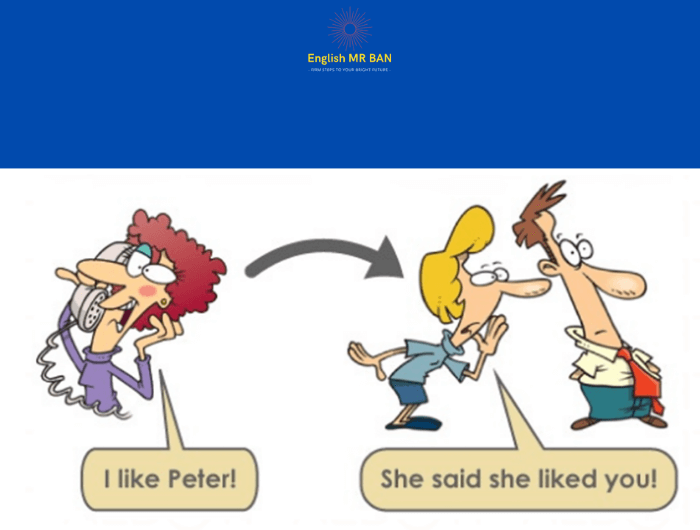
Chú ý :Các trường hợp không đổi thì khi chuyển sang câu gián tiếp
1. Sự thật, sự việc luôn luôn đúng:
Ví dụ :
-“The earth moves round the sun” he said.–> He said that the earth moves round the sun.
– They said: “Sai Gon is busier than Hanoi ”–>They said Sai Gon is busier than Hanoi.
Ví dụ :
-“If I were you, I would leave here” he said.–> He said that if he were me, he would leave there.
3.Wish + past simple/ past perfect:
Ví dụ :
-“I wish I lived in Da Nang”, he said.–> He said he wished he lived in Da Nang.
4.Cấu trúc “it’s time somebody did something”:
Ví dụ :
– “It’s time he woke up”, she said.–> She said it was time he woke up.
5.Would/ should/ ought to/ had better/ used to không chuyển:
Ví dụ :
– “ You’d better work hard” he said–> He said that I had better work hard.
6. Thì quá khứ hoàn thành không chuyển.
7.Các câu có cấu trúc với if only, as if, as though, would rather
III. Cách thay đổi cụ thể cho từng loại câu trong lời nói gián tiếp.
1.Câu trần thuật (statement)
Direct: S + V + (O) : “clause”
Indirect: S + told / said + (O) + (that) + clause
Note: said to → told
Ví dụ :
– Tim said, “I want to visit my friend this weekend.”→ Tim said (that) he wanted to visit his friend that weekend.
– She said to me, “I am going to HCMC next summer.”→ She told me (that) she was going to HCMC the following summer.
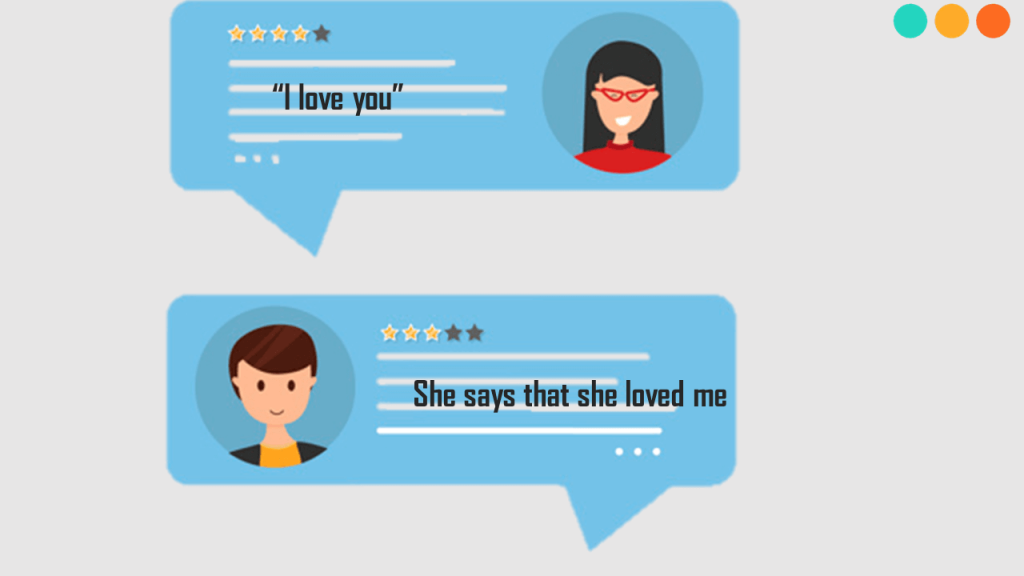
2.Câu hỏi (questions)
a. Yes – No questions
Direct: S + V + (O) : “Aux. V + S + V1 + ….?”
Indirect: S + asked + O + if / whether + S + V + ….
Ví dụ :
– He asked: “Have you done your homework, Chi?”→ He asked Chi if / whether she had done her homework.
-“Did you go out last night, Tuan?” I asked→ I asked Tuan if / whether he had gone out the night before.
b. Wh – question
Direct: S + V + (O): “Wh- + Aux. V + S + V1 + …?”
Indirect: S + asked + O + Wh- + S + V + ….
Ví dụ :
– “How long are you waiting for the bus?” he asked me→ He asked me how long I was waiting for the bus.
– “Where are you from?” she asked my friend→She asked my friend where she came from?
3.Câu mệnh lệnh, câu đề nghị ( Commands/Requests)
– Mệnh lệnh khẳng định:
Direct: S + V + O: “V1 + O …”
Indirect: S + asked / told + O + to-inf + ….
Ví dụ:
– He said to her: “Keep silent, please.”→ He told her to keep silent.
– “Wash your hands before having dinner, Lan.” the mother said.→ The mother told Lan to wash her hands before having dinner.
– Mệnh lệnh phủ định:
Direct: S + V + O: “Don’t + V1 + …”
Indirect: S + asked / told + O + not + to-inf ….
Ví dụ :
-“Don’t forget to phone me this afternoon,” he said.→ He reminded me to phone him that afternoon.
– The teacher said to the students: “Don’t talk in the class.”→ The teacher told the students not to talk in the class.
Tùy theo ngữ cảnh trong lời nói động từ tường thuật said hoặc said to có thể đổi thành told, asked, advised, persuaded, directed, begged, encouraged, reminded ..
Ví dụ :The doctor said to his patient: “Do exercise regularly.”→ The doctor advised his patient to do exercise regularly.
4. Động từ nguyên mẫu (TO-INFINITIVE) trong lời nói gián tiếp.
Khi lời nói gián tiếp là một lời đề nghị, mệnh lệnh, ý định, lời hứa, lời yêu cầu, …động từ tường thuật cùng với động từ nguyên mẫu theo sau nó thường được dùng để chuyển tải nội dung lời nói này.
a. Reporting Verb + To-inf …
– agree ( đồng ý), demand (đòi hỏi), guarantee (bảo đảm)
– hope,promise,swear (thề)
– threaten (đe dọa),volunteer ( tình nguyện), offer (đưa ra đề nghị)
– refuse ( từ chối), consent (bằng lòng), decide ( quyết định)
Ví dụ :“I will give you my book if you need it,” said my friend.→ My friend offered to give me her book if I needed it.
b. Reporting Verb + Object + To-inf …
– ask (bảo, yêu cầu),advise (khuyên),command (ra lệnh)
– expect (mong đợi),instruct (hướng dẫn),invite (mời)
– order (ra lệnh), persuade (thuyết phục),recommend (khuyên)
– remind (nhắc nhở),encourage (cổ vũ),tell (bảo)
– urge (thúc giục),warn (cảnh báo),want (muốn, mong muốn)
Ví dụ :
-“Don’t forget to lock the door,” I said to my sister.→ I reminded my sister to lock the door.
– Van said: “Come to my place whenever you are free.”→ Van invited me to come to her place whenever I was free.
Chú ý :
1. Lời đề nghị:
– Would you / Could you / Will you / Can you → asked + someone + to-inf
– Would you mind / Do you mind + V-ing → asked + someone + to-inf
Ví dụ :
-“Can you read the instructions again?” she said.→ She asked me to read the instructions again.
– He said: “Would you mind opening the door, please?”→ He asked me to open the door.
5. DANH ĐỘNG TỪ (V-ING) TRONG LỜI NÓI GIÁN TIẾP
Khi lời nói trực tiếp là lời đề nghị , chúc mừng, cảm ơn, xin lỗi, …động từ tường thuật cùng với danh động từ (V-ing) theo sau nó thường được dùng để chuyển tải nội dung lời nói trên.
a. Reporting Verb + V-ing + ….
Deny (phủ nhận), admit (thừa nhận), suggest (đề nghị), regret (nuối tiếc), appreciate (đánh giá cao, cảm kích)
Ví dụ :
– Peter said: “I didn’t steal the painting.”→ Peter denied stealing the painting.
-“Why don’t we go out for a walk?” said the boy.→ The boy suggested going out for a walk.
b. Reporting Verb + (Someone) + Preposition + V-ing + ….
– thank someone for (cám ơn ai về ….)
– accuse someone of (buộc tội ai về …)
– congratulate someone on (chúc mừng ai về ….)
– warn someone against (cảnh báo ai về ….)
– dream of (mơ về …)
– object to (chống đối về ….)
– apologize someone for (xin lỗi ai về …)
– insist on (khăng khăng dòi …)
– complain about (phàn nàn về ….)
Ví dụ :
-“I’m happy to know that you win the game. Congratulations!”, Jim said to Mary.→ Jim congratulated Mary on winning the game.
-Daisy said: “Thank you for helping me”→ Daisy thanked me for helping her.
Chú ý những cấu trúc gợi ý sau:
1. Why don’t you / Why not / How about → suggested + (someone) + V-ing …
Ví dụ :
-“Why don’t you send her some flowers?” he said.→ He suggested me sending her some flowers.
2. Let’s → suggested + V-ing …
Let’s not → suggested + not + V-ing …
Ví dụ :
-“Let’s meet outside the cinema,” he said.→ He suggested meeting outside the cinema.
-She said: “Let’s not talk about that problem again.”→ She suggested not talking about that problem again.
3. Shall we / It’s a good idea → suggested + V-ing …
Ví dụ : “It’s a good idea to go for a picnic this weekend,” she said.→ She suggested going for a picnic that weekend.
IV. Cách cách chuyển đổi cơ bản từ câu trực tiếp sang gián tiếp
1. Say that + a statement –> agree (đồng ý), refuse (từ chối), offer (đề nghị), promise (hứa), threaten (dọa) + the infinitive
Ví dụ :
-“All right, I’ll help you” he said.–> He agreed to help me.
-“ Oh, no, I won’t come to your party”, he said.–> He refused to come to my party.
-“I’ll look for the cat for you tomorrow if you like” he said.–> He offered to look after the cat for me the next day if I liked.
-“I’ll visit your parents when I arrive there”, he said–> He promised to visit my parents when he arrived there.
-“I’ll sell the TV set if you keep on watching it all day”, said the father–> The father threatened to sell the TV set if he kept on watching it all day
2. Say that + a statement–> accuse …of (buộc tội), admit (thừa nhận), apologise for (xin lỗi), deny (từ chối), insist on + V-ing (khăng khăng)
Ví dụ :
-“You stole the jewels” said the inspector–> The inspector accused her of stealing the jewels.
-“I’ve made the wall dirty” said one student.–> One student admitted making the wall dirty.
-“I’m sorry I’m late” she said.–> She apologized for being late.
-“No, we didn’t enter the garden” said the boy.–> The boy denied entering my garden.
-“Certainly, I’ll buy that car for you”, said he.–> He insisted on buying me that car.
3. Say to somebody + a statement –> told somebody + that + clause
Ví dụ:
-“I’ve finished all my homework”, he said to me.–> He told me that he had finished all his homework.
4. Say + a statement –> said that + clause
Ví dụ :
“I’m going to Hanoi tomorrow”, he said.–> He said that he was going to Hanoi the next day.
5. Statement with command, request, advice, invitation, offer –> advise, ask, beg, encourage,
invite, order, tell, warn, remind…to Vinfi
Ví dụ:
-“You’d better hurry”, he said.–> He advised me to hurry.
-“Post the letter for me, will you?”he said.–> He asked me to post the letter for him.
-“Make another try, please”, he said.–> He encouraged me to make another try
-“Don’t drive too fast”, he said.–> He warned me not to drive too fast.
-“Remember to close the door”, he said.–> He reminded me to close the door.
-“Don’t forget to come at 6 a.m tomorrow”, he said.–> He reminded to come at 6 a.m the next day.
6. Questions in indirect speech :thời, đại từ, tính từ sở hữu, trạng từ chuyển như ở câu tường thuật.
– Yes-no questions –> asked/wanted (to know) if/whether
Ví dụ :“Are you absent from your classes today?” he asked.–> He asked/wanted to know if I was absent from my classes that day.
– Wh-questions –> asked/wanted (to know) + question word + clause. [Câu hỏi bắt đầu who, whom, what, which,where, when, why, how: Các từ để hỏi trên sẽ được giữ nguyên trong câu gián tiếp:]
Ví dụ :
-“Where do you often meet your friends?” she said.–> She asked where I often met my friends.
7. Questions with “shall I…”–> 4 loại sau:
• About future event (sự kiện trong tương lai)
Ví dụ :“Shall we attend the meeting tomorrow”, she said.–>She asked if they would attend the meeting the next day
• Request for instruction or advice (Lời hướng dẫn hoặc lời khuyên)
Ví dụ :“Shall I read it, mother?” he said.–> He asked his mother if he should read it.
• Offer to do something ( giúp làm gì)
Ví dụ :-“Shall we bring you some new books?” she said.–> She offered to bring me some new books.
• Suggest to do something (gợi ý làm gì)
Ví dụ :“Shall we go to the cinema tonight”, he said.–> He suggested going to the cinema that night.
8.Questions with “Will you, would you, could you…?” (yêu cầu, đề nghị, mời)–> offer, invite, order,ask, tell.
Ví dụ :
-“ Will you come to my party tomorrow?” he said.–> He invited me to come to his party the next day.
-“Could you get ready at 6p.m tonight?” he said.–> He told/asked me to get ready at 6p.m that night.
-“Would you like some cigarettes?” he said.–> He offered me some cigarettes.
-“Will you shut your mouth?” he said.–> He ordered me to shut my mouth.
9. Let’s do…–> suggest + V-ing (nếu bao gồm cả người nói thực hiện hành động)
và Let’s do…–> suggest + that Subject should do…(có thể bao gồm hoặc không bao gồm người nói thực hiện hành động)
Ví dụ :
“Let’s go to the cinema tonight”, he said.–> He suggested going to the cinema that night. (anh ta cũng đi)
và –> He suggested that they should go to the cinema that night
10. Yes, let’s do…–> agree
No, let’s not do… –> be against the idea.
Ví dụ :
-“Let’s eat out tonight” said the mother.
“Yes, let’s” said the son.
“No, let’s not” said the father.
–> The mother suggested eating out that night and the son agreed but the father was against the idea.
11. Must –> had to
Ví dụ :
-“I must finish my work tomorrow”, he said.–> He said that he had to finish his work the next day.
-“Must you go soon?” she said.–> He asked if I had to go soon.
12. Câu cảm thán trong lời nói gián tiếp
• What + a + noun! /how + adj–> said that + clause
–> gave an exclamation of delight (vui mừng, tán thưởng), disgust (kinh tởm), honor (sợ), surprise (ngạc nhiên)
Ví dụ :
-“How beautiful the picture is”, he said.–> He said that the picture was beautiful
–> He exclaimed that the picture was beautiful
-> He gave an exclamation of delight.
-“What a dirty kitchen!” she said.–> She said that the kitchen was dirty.
–> She gave an exclamation of disgust.
-“How wonderful”, he said.–> He said that it was wonderful.
–> He gave an exclamation of surprise.
13. “Yes/no” –> subject + trợ động từ
Ví dụ :
-“Have you finished your homework?”he said
“Yes”, she said
–> He asked her if she had finished her homework and she said she had.
-“Are you ready for the exam?” he said.
“No”, she said.
–> He asked if she was ready for the exam and she said she wasn’t.
14. “Thank”–> subject + thanked
Ví dụ :
-“Would you like to have dinner with me tonight?”, he said.
“Thank you, I’d love to” she said.
–> He invited her to have dinner with him that night. She thanked him and said she would love to.
-“Good luck”, he said –> he wished me luck.
-“Congratulation!”, he said –> he congratulated me.
V. Bài tập thực hanh câu trực tiếp -gián tiếp (reported speech)
Chuyển các câu sau từ trực tiếp sang gián tiếp
1.“Where are you from?” he asked.
⇒ He asked me…
2.“The band is going to have a comeback next month” The producer said
⇒ The producer said…
3.“I never make mistakes,” he said.
⇒ He said….
4.“I will get myself a drink,” she says
⇒ She said….
5.“Don’t forget your computer,” she told me
⇒ She told me ….
6.“Don’t touch it,” she said to him.
⇒ She told him…
7.“I often have a big hamburger.”, Minh says.
⇒ Minh said….
8.“Shall I do the cleaning up for you?” he said.
⇒ He offered…
9.“How ugly!” he said
⇒ He exclaimed…
10.“Would you like to come to my birthday party next Saturday?” she said.
⇒ She ……
11. “Give me the mirror,” she told him.
⇒ She asked him…
12. “Which shoes do you like best?” she asked her friend.
⇒ She asked her friend…
12. “Would you like to go party with me?” she said to Paul.
⇒ She invited Paul….
14. “Are you enjoying novel?” I said to Jessi.
⇒ I asked Jessi…
15. “I’ll phone you tomorrow,” she told Daniel.
⇒ She told Daniel that….
1 6. “I’m very sorry I gave you the wrong schedule,” She said to Hope
⇒ She apologized…
17. “Party will not be served after 12 p.m” staff said.
⇒ Staff said that…
18. “Please, please come to help me with the messy room,” my sister told me.
⇒ My sister begged me……
19.She said, “Go upstairs.”
→ She told me ………………………………………….. .
20. “Close the door behind you,” he told me.
→ He told me ………………………………………….. .
21. “Don’t be late,” he advised us.
→ He advised us ………………………………………….. .
22. “Stop staring at me,” she said.
→ She told him ………………………………………….. .
23. “Don’t be angry with me,” he said.
→ He asked her ………………………………………….. .
24. “Leave me alone,” she said.
→ She told me ………………………………………….. .
25. “Don’t drink and drive,” she warned us.
→ She warned us ………………………………………….. .
26. “John, stop smoking,” she said.
→ She told John ………………………………………….. .
27. “Don’t worry about us,” they said.
→ They told her ………………………………………….. .
28. “Meet me at the cinema.” he said.
→ He asked me ………………………………………….. .
29. He said, “I like this song.”
→ He said ………………………………………….. .
30. “Where is your sister?” she asked me.
→ She asked me ………………………………………….. .
31. “I don’t speak Italian,” she said.
→ She said ………………………………………….. .
32. “Say hello to Jim,” they said.
→ They asked me ………………………………………….. .
33. “The film began at seven o’clock,” he said.
→ He said that ………………………………………….. .
34. “Don’t play on the grass, boys,” she said.
→ She told ………………………………………….. .
35. “Where have you spent your money?” she asked him.
→ She asked him ………………………………………….. .
36. “I never make mistakes,” he said.
→ He said ………………………………………….. .
37. “Does she know Robert?” he wanted to know.
→ He wanted ………………………………………….. .
38. “Don’t try this at home,” the stuntman told the audience.
→ The stuntman advised ………………………………………….. .
39. “I was very tired,” she said.
→ She said ………………………………………….. .
40. “Be careful, Ben,” she said.
→ She told ………………………………………….. .
41. “I will get myself a drink,” she says.
→ She said ………………………………………….. .
42. “Why haven’t you phoned me?” he asked me.
→ He wondered ………………………………………….. .
43. “I cannot drive them home,” he said.
→ He said ………………………………………….. .
44. “Peter, do you prefer tea or coffee?” she says.
→ She asked ………………………………………….. .
45. “Where did you spend your holidays last year?” she asked me.
→ She asked ………………………………………….. .
46. He said, “Don’t go too far.”
→ He advised her ………………………………………….. .
47. “Have you been shopping?” he asked us.
→ He wanted ………………………………………….. .
48. “Don’t make so much noise,” he says.
→ He asked ………………………………………….. .
Trên đây là bài viết chi tiết về câu trực tiếp gián tiếp (reported speech) trong tiếng Anh. Hướng dẫn chi tiết cách chuyển từ các dạng câu trực tiếp sang gián tiếp. Học kỹ lý thuyết các quy tắc, tình huống câu và làm nhiều bài tập sẽ giúp bạn hiểu sâu về chủ điểm ngữ pháp này !
Better your English each day !
English Mr Ban